
Short Answer
Franz Josef Land (Russian: Земля Франца‑Иосифа) lies in the high Arctic of the Barents Sea and forms the northernmost extension of Russian territory. Its rugged, ice‑capped islands provide sheer cliffs, ice‑free ledges and sheltered bays that are ideal nesting sites for a diversity of seabirds. Systematic surveys, most notably the VNIIPriroda expedition of 1980–81, have documented the archipelago’s avifauna in detail, revealing a total of 37–38 species, of which 14 breed regularly.
The seabird community is of particular scientific and conservation interest because the islands host the largest nesting colonies of ivory gulls (Pagophila eburnea) ever recorded in the former USSR, and more than sixty major cliff colonies of several other species. These colonies are integral to the Arctic food web, linking marine productivity with terrestrial predators such as polar bears and Arctic foxes.
Species Overview
The seabirds of Franz Josef Land belong to several families within the orders Charadriiformes and Procellariiformes. The most abundant and ecologically significant groups are:
- Alcidae – auks and guillemots
- Laridae – gulls and terns
- Procellariidae – fulmars and other petrels
In addition to these, a few rarer visitors such as the Sabine’s gull (Xema sabini) and the Ross’s gull (Rhodostethia rosea) have been recorded during migration periods.
Distribution
Franz Josef Land’s seabird distribution follows the classic circumpolar pattern: species are largely confined to the high‑latitude seas of the Barents and Kara oceans. Most species are marine specialists that spend the winter at sea and return to the archipelago for the brief Arctic summer (June–August) to breed. Non‑breeding visitors, including Arctic terns and several gulls, may use the islands as stop‑over sites during long‑distance migrations.
Habitat in Franz Josef Land
Breeding habitats fall into three principal categories:
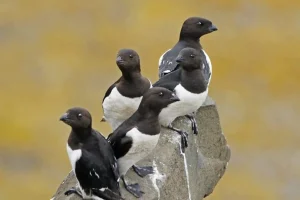
- Cliff ledges and sea‑cave systems: Steep basaltic cliffs on islands such as Rudolf Island, Hooker Island and Graham Bell Island provide nesting sites for little auks (Alle alle), Brünnich’s guillemots (Uria lomvia), black guillemots (Cepphus grylle) and kittiwakes (Rissa tridactyla).
- Ice‑free tundra and low‑lying meadows: These areas support the ground‑nesting ivory gull, which prefers open, snow‑free ground for its shallow scrapes.
- Coastal ice edges and pack‑ice floes: Fulmars (Fulmarus glacialis) and some gulls forage and sometimes nest on ice floes adjacent to the islands.
Because the archipelago is largely glaciated, ice‑free zones are limited to narrow coastal belts and the tops of a few nunataks, concentrating seabird colonies in these accessible habitats.
Diet and Feeding
Seabirds in Franz Josef Land are predominantly piscivorous, exploiting the rich zooplankton and fish assemblages of the Barents Sea. Typical prey includes Arctic cod (Boreogadus morhua), polar cod (Theragra newnesi), euphausiids and amphipods. Ivory gulls are more opportunistic, scavenging on carrion and seal remains, while auks dive to capture small fish and invertebrates. Fulmars are surface feeders, often taking prey items from the water’s surface or from floating carrion.
Breeding and Life Cycle
Breeding timing is tightly synchronized with the Arctic summer. Arrival dates range from late May (for early‑nesting auks) to early June (for gulls and fulmars). Nesting periods are short:
- Egg‑laying occurs in early to mid‑June.
- Incubation lasts 21–30 days, depending on species.
- Chick rearing extends another 30–45 days before fledging in late July or early August.
Most species are monogamous within a season, with both parents sharing incubation and chick‑feeding duties. The rock ptarmigan (Lagopus muta), although not a seabird, is a permanent resident and may be observed foraging near seabird colonies.
Relationship to Sea Ice
Sea‑ice dynamics exert a profound influence on breeding success. Species such as the ivory gull are ice‑dependent; loss of winter sea‑ice reduces available foraging habitat and can force gulls to travel farther to find food, lowering chick survival. Conversely, auks and guillemots rely less directly on sea‑ice but are affected by changes in prey availability linked to ice cover.
Conservation Status
All seabird species recorded on Franz Josef Land are listed on the IUCN Red List, ranging from Least Concern (e.g., little auk) to Vulnerable (ivory gull). The archipelago is part of the Russian Arctic National Park, affording legal protection to breeding colonies. However, historic hunting of ivory gulls and ongoing climate‑driven ice loss remain significant threats.
Research and Monitoring
Systematic monitoring began with Soviet ornithologists in the 1930s and intensified after the 1980–81 VNIIPriroda expedition, which produced the most comprehensive species inventory to date. Contemporary research involves satellite telemetry of gulls, annual colony counts by the Russian Academy of Sciences, and collaborative projects with BirdLife International to assess population trends.
Identification
| Common Name | Scientific Name | Breeding Status | IUCN Red List |
|---|---|---|---|
| Ivory Gull | Pagophila eburnea | Breeds | Vulnerable |
| Little Auk | Alle alle | Breeds | Least Concern |
| Brünnich’s Guillemot | Uria lomvia | Breeds | Least Concern |
| Black Guillemot | Cepphus grylle | Breeds | Least Concern |
| Northern Fulmar | Fulmarus glacialis | Breeds | Least Concern |
| Black‑legged Kittiwake | Rissa tridactyla | Breeds | Least Concern |
| Arctic Tern | Sterna paradisaea | Non‑breeding visitor | Least Concern |
| Sabine’s Gull | Xema sabini | Rare visitor | Least Concern |
| Ross’s Gull | Rhodostethia rosea | Rare visitor | Least Concern |
Field identification relies on distinguishing plumage patterns, bill shape and vocalizations. For example, the ivory gull’s pure white plumage and yellowish bill contrast sharply with the black‑legged kittiwake’s grey‑white head and bright orange bill.
FAQ
How many seabird species breed on Franz Josef Land?
Fourteen seabird species are confirmed breeders, based on surveys up to the early 1980s.
Why is the ivory gull considered a conservation priority in the archipelago?
Ivory gulls form the largest nesting colonies of the species in the former USSR and are listed as Vulnerable due to their dependence on sea‑ice and historic hunting pressures.
What are the main threats to seabird colonies in Franz Josef Land?
Climate‑induced loss of sea ice, which reduces foraging habitat, and potential disturbance from increased human activity are the principal threats.
Leave a Reply